New tenant, increased prospects build momentum at USD Discovery District
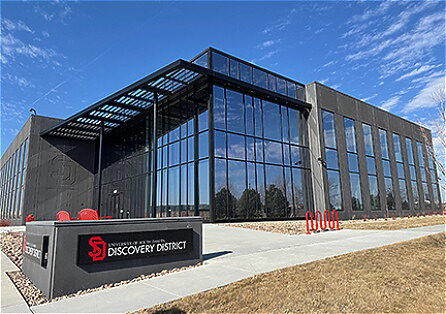
Space is starting to fill up at the University of South Dakota Discovery District’s first building as the state’s only life science research park is honing its approach to pursuing new prospects.
“We’re seeing renewed momentum in the bioscience industry, and South Dakota specifically has significant opportunities,” said Ryan Oines, president and CEO of the USD Discovery District.
“I really think if we take our existing infrastructure and build on it, we’re a fit for organizations of all sizes, especially in the health care sector, as well as universities doing research and applying that toward commercialization.”
Building 1 has approximately 24,000 square feet available for build-out, and activity is picking up.
The nonprofit Community Action for Veterans has leased a four-person office area, helping the organization evolve from a one-person operation to a growing regional hub for veteran and family wellness.
Its expansion is supported by a $345,000 federal award through the U.S. Department of Veterans Affairs’ Staff Sergeant Parker Gordon Fox Suicide Prevention Grant Program, supporting expanded outreach, research and care coordination for veterans across 14 eastern South Dakota counties.
“This funding allows us to reach veterans who are not connected to the VA system — the ones who often fall through the cracks,” said Jill Baker, executive director of Community Action for Veterans. “Much of what is considered best practice in veteran care has been developed for urban environments. We need research-informed systems that work in rural states like ours.”
Founded in 2013 as a volunteer Community Veterans Engagement Board, CAV formally incorporated as a nonprofit in 2022. Since then, the organization has expanded programming focused on upstream suicide prevention, including addressing housing instability, financial hardship, food insecurity and social isolation — key risk factors identified in suicide prevention research.
The federal grant enables CAV to hire additional staff, including a care coordinator and a community outreach coordinator, tripling its staffing capacity and strengthening its ability to provide direct outreach and care coordination. The nonprofit also is embedding social work interns through partnerships with the University of South Dakota and Augustana University, strengthening both service delivery and data-informed evaluation.
The expansion marks a foundational moment for the organization, said Janet Brekke, president of the CAV board of directors.
“We’ve been building the plane while flying it,” Brekke said. “This grant allows us to put wings beneath it, building infrastructure that ensures veterans and their families don’t face barriers to care.”
CAV’s move into the USD Discovery District reflects a growing collaboration among community health, higher education and regional economic development, Oines said.
“We’re excited to serve as a hub for university-supported research, a student workforce and private industry,” he said. “Our goal is to create an environment where tenants, partners and stakeholders can connect through our broader network to generate meaningful collaboration.”
The 50,000-square-foot Building 1 opened in 2025, including its first biotech tenant, diagnostics company OmegaQuant, and several offices with tenants offering business services that complement the needs of future Discovery District companies.
“Interest has increased as we’ve been intentional about our recruiting and marketing efforts,” Oines said. “We’re working with a medical device company that supports rehabilitation and mobility needs, and we have a lease with a bioengineering firm focused on plant health.”
The 2025 South Dakota Bioscience Market Study, a comprehensive analysis of the state’s emerging strengths in bioscience, life sciences and technology-driven research, is helping provide a road map.
The report outlines how South Dakota’s affordability, development speed and collaborative public-private environment are positioning the region as a competitive location for early-stage and growth-stage bioscience companies.
“There’s this perspective with research districts that it’s all lab coats and research, but what has worked best throughout the country and has been part of our strategic plan for years is a focus on place-making,” Oines said. “We recognize there may be additional infrastructure we could add that would specifically support med tech or biotech companies, but there also are live-work needs like housing, as well as food and beverage, hospitality and other supporting services, and we’ll work with partners to try and secure those ancillary services. Otherwise, organizations that are growing aren’t going to have an appetite to come to our neck of the woods.”
The 2025 study highlights several key advantages for the Discovery District:
- Operating runway: The same capital that lasts five years on the coasts can last up to 10 years in South Dakota.
- Development speed: Faster permitting, predictable processes and aligned partners reduce friction for companies building complex scientific infrastructure.
- Research and clinical capacity: USD’s expanding biomedical, engineering and AI programs, when combined with regional health system partnerships, create a growing talent and research pipeline.
- Infrastructure readiness: The completion of Building 1, a purpose-built multi-tenant lab and innovation facility, signals that the state is ready for research, scale-up and commercialization activity.
- Regional positioning: Sioux Falls is emerging as a competitive node in the Midwest bioscience corridor and is seeing increased interest from national and international partners.
“South Dakota is not trying to replicate Boston or San Diego,” said Tung Nguyen, partner at Thel Consulting and project director of the study. “We are building an environment that reflects who we are: clear, collaborative and fast. The data shows that when companies operate in a place where friction is lower, their progress accelerates. That is a meaningful competitive advantage.”
The study and recent leasing success are encouraging, said Joni Ekstrum, executive director of South Dakota Biotech.
“South Dakota, Sioux Falls and the USD Discovery District all offer unique advantages for biotech companies,” she said. “Having a building ready to go or prepared for build-out shows we’re for real, and it’s starting to gain traction.”
The support of South Dakota Biotech, the state affiliate of industry-leading organization BIO, is key, Oines said.
“We really appreciate their support,” he said. “They’re engaged with us and well positioned to support our tenants. We’re looking forward to more opportunities to collaborate.”
The USD Discovery District also continues to elevate its presence regionally. It was a sponsor at the recent 2026 Medical Alley Summit in Minneapolis, an annual event that brought together more than 300 founders, senior executive leaders, investors, researchers and policy experts.
“It was a great event, and we had valuable conversations with a number of higher education and private industry partners,” Oines said. “The biggest benefit is intersecting with the others who attend. The more we can tell our story, the greater our chances of connecting with organizations that are the right fit for what we’re building.”